I made a video for some of the new guys going to Plataiai back in 2022 on the basics of spear fighting. It is rough, but I thought I would share it here.
Friday, February 23, 2024


The Face of Battle at Plataiai

On the field of Plataiai 2022
I am linking to an article I wrote with Roel Konijnedijk which summarizes most of the thoughts on the transition of hoplite tactics between the Archaic and classical period.
Konijnendijk, Roel / Bardunias, Paul M. (2022) “The Face of Battle at Plataiai.” In Andreas Konecny and Nicholas Sekunda (eds.), The Battle of Plataiai, 479 BC (Phoibos Verlag: Vienna, 2022) pp. 211-242 https://www.academia.edu/77994737/The_Face_of_Battle_at_Plataiai
Monday, December 19, 2022
The Clash of Shield-walls at Plataea
I have not posted on here for a long time, but I have not been idle. Last spring I gave a lecture at the 2022 Battle of Plataea conference at Harvard's Center for Hellenic studies on the hoplite combat and the clash of Greek and Persian shield-walls.
https://youtu.be/Sjypd4iSTnw?si=mqDHRATiNipMcQy0
Thursday, July 12, 2018
The Linothorax
The Linothorax

The ancient
Greeks knew that armor could be made of linen, woven from fibers of the flax
plant, (Linum usittatisimum L.). Anyone
at recitation of Homer’s Iliad would have heard Ajax the Lesser described with
the term “linothorex”, thus “linen cuirassed” (Il.2.529). The current debate centers on whether or not
we can apply the term “linothorax” to a specific type of armor that is widely seen
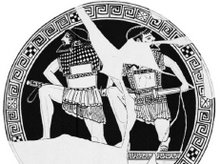
depicted on vase imagery and in sculpture. The earliest depictions of hoplites
show them to be armored in bronze plate, but 6th century BC saw the
emergence of a new type of corselet that was probably constructed of organic
materials given the lack of archaeological evidence. Woven linen and leather
have been suggested for the base material, but there is no agreement as to
which is more likely. I will present
arguments for and against each, and hope to foster a consensus.
This armor was used from Skythia to
North Africa, and remained in use alongside the plate cuirass throughout the
Classical and Hellenistic periods. Almost
all of the details of its construction are garnered from vase images, many of
which are quite detailed, with archaeological finds limited to metal fittings
and a single rendering of the type done in iron from a late 4th
century Macedonian royal tomb at Vergina.
The armor consisted of two main
portions. The torso was protected by a
“tube” or “box” that wrapped around the body, was scalloped to fit under the
arms, and had a raised panel to cover the upper chest. Many of these corslets show broad bands
across the upper chest and midsection decorated with a key pattern or similar
design. Just above the hips, the bottom
of the tube was cut into strips, pteryges, which facilitated bending,
while covering the lower abdomen. Usually
there was a double layer of pteryges, which were staggered so that the inner
layer filled gaps created in the outer layer as the hoplite moved.
Most images show hoplites fastening
the tube by means of thongs tied at the left, front to form a cylinder, perhaps
because the left side of a hoplite was covered by his large shield. There seems to have been variation in exactly
how the tube section was brought together.
The side panel may have simply been butted to the front panel and
secured, but the single extant copy of the armor from Vergina is double
breasted, overlapping the chest region from both directions. Other images, like that on a vase from the
Museo Etrusco Gregoriano (inv. 16583), show a tab with no pteryges of about a quarter the width of the chest panel wrapping
around in front. This would serve to
cover the seam where the sections meet.

Affixed to
the upper back of the tube, or perhaps cut from the same piece of material, was
a panel that protected the shoulders.
Two flaps, epomides, arose from this and extended over the
shoulders like a “yoke” to be tied down to the chest panel. The epomides were generally long and
broad, especially in the early period, extending well down the chest and flaring
out laterally from along side the neck to just before or beyond the
shoulders. There manner in which the
flaps were tied down could be complex, with thongs simply attaching to lateral
rings, crossing the chest to secure on opposite sides, meeting in the center,
or apparently passing through lateral and central attachment points. One advantage of this system was to allow the
epomides to be secured and tensioned independently. For a hoplite this was important because he
spent much of his time with his arm raised for overhand strikes with the
spear. If weight were distributed evenly
between the shoulder flaps when the arms are lowered, then it would have been
disproportionally borne on the right shoulder as the arm was raised. Another aid in the overhand strike was that
the thongs on the epomides emerge close to their inner edge. Thus, when
the arm was lifted, the shoulder flaps naturally hinge up on their inner
edge. Between the two shoulder flaps a
square section arose to stand up behind the back of the neck.
Because the term linothorax implies
a mode of construction, I will use a term for the armor based on the morphology
just described instead of material: the “Tube and Yoke” (T-Y) corslet. It is difficult to determine when this armor
type first appeared in the Greek world.
Hoplites wore only a simple tunic or chitoniskos beneath their
cuirasses, so there was nothing like an arming doublet that could have
developed into an organic armor. There
also was no armor with these characteristic seen outside of Greece
In close combat a hoplite could
shelter most of body behind his shield, but his head and often his shoulders
would go uncovered as he fought. Attacks
coming from above might glance off the helmet onto the shoulders or impact them
directly. When battles came to pushing, othismos,
the broad, flat surface of the flap as it lies over the left front chest
provided a perfect surface to rest the bottom of the shield rim against. Interestingly, while the broad epomides
seen on some vases overlapping the shoulder would have allowed the inner rim of
the bowl-shaped shield to rest upon them when marching, pushing with the
shoulder in this position would force the flap into the hoplite’s neck.
 |
Hoplites donning their armor
|
Many cultures had armors made of
textile or leather, and quilted armor existed in Greece during the Mycenaean
period. These armors usually look like a
vest or jacket. One reason for the T-Y’s
shape would be that the material from which it was constructed was particularly
stiff. Much has been made of images that
show epomides springing back to stand straight up when unsecured, but
the need to cut pteryges into the bottom of the tube to allow for
freedom of movement when bending also indicates stiffness. These corslets are shown holding their form when
not being worn, as on a vase at Zurich University (L5). The apparent stiffness of the corslet has
meant that any material that cannot be rendered this stiff has been rejected as
a base for the armor.
The form of the T-Y corslet has a
major advantage over vest-cut armor that pulls over the head. Hoplites could quickly undo the thongs tying
the armor together to allow for air flow.
Anyone who has worn body armor or sports pads, such as football shoulder
pads, knows that simply unfastening them in this manner cools the body
greatly. There are vase images that show
hoplites in a characteristic state of undress, with the tube unfastened and
hanging opened on the left side and the shoulder flap on the opposite side
undone.
 |
| Me in my spolas of leather in an at ease position with the weight suspended from only the left shoulder. |
They are usually portrayed as white
on black-ware vases of the latter 6th c BC. Usually, white was reserved for organic
components, such as the flesh tone of female figures, sword hilts, and chitons
that were probably textile. Some of
these chitons extended to mid-thigh and show a crosshatched pattern that
might show quilting, perhaps indicating that these were a light armor in their
own right. Early T-Ys show very broad epomides, often meeting in the
middle of the chest. By the end of the 4th
c BC, the epomides are move to the side of the chest and are generally
reduced in length and width. Perhaps
this reflects a move away from hoplite tactics.
The corslet also becomes higher waisted and one or two additional tiers
of pteryges are added extending down the thighs. Pteryges are sometimes seen at the
shoulders as well, perhaps to make up for the epomides reduction in
size.
Adding metal scales, bronze, rawhide, or iron, was a common feature of these armors. The variation in shape, number and placement on the armor is staggering. So much so that I would caution trying to draw too many conclusions, such as how weapons were used, based on scale placement. But this article shall focus mainly on the base material. I will note that it is unclear that scales add protection rather than add flexibility for the same level of protection.

Linen
The first reference to linen armor
that is truly relevant to the T-Y corslet comes from the poet Alcaeus, born to
an aristocratic family from Mytilene on Lesbos around 620 BC. In a poem of the early 6th c, he
describes arms and armor, probably hanging in a temple. There are obvious hoplite accoutrements, such
as bronze greaves and hollow shields, but among these he writes of “White corslets
of new linen” (fr. V 140). He and his older brother Antimenidas served
as mercenaries for the Egyptians and Babylonians respectively. Hoplite mercenaries serving abroad may have
brought home new types of armor, or ideas for making armor from new materials.
Herodotus describes a number of
linen corselets in foreign use. He tells
us that Amasis, King of Egypt, sent “Thorakes
lineoi” to the temple of Athena at Lindos (Hdt. 2.182) and Sparta
Xenophon also describes another
Anatolian people of his own day, the Chalybians, as wearing line “thorakes” with “a thick fringe of
plaited cords instead of pteryges” (Xen. Anab. 4.7.15). This is a
reference to the T-Y corselet based on the pteryges, but we must be
cautious in reading too much into the reference. He does not clearly state that the Greek corslets
are linen as well, only of similar form.
There is a somewhat muddled
reference to linen armor in Xenophon’s day that is often cited in support of
the T-Y being a textile armor. Cornelius
Nepos, in his life of Iphicrates, mentions that among the other military reform
the general enacted was switch from “linked or brazen” to linen armor (Nep.
Iph. 1.4). Not only is his mention of
mail armor anachronistic, but this change in armor is missing from our other main
source for his reforms (Dio. Sic. 15.44). More troubling, and seemingly overlooked by
proponents of linen being commonly used during the Classical period, this shift
was described as a reform, a new addition to the panoply, and so not a common
item.
Probably the most reliable evidence
for the use of linen armor in the 4th century comes from Aeneas Tacticus
written about 350 BC. In describing how
weapons in one instance were smuggled into a city, he lists among the armor
brought in “Thorakes lineoi” (Aen.
Tactic. 29.1-4). We shall return to this reference later.
When Alexander the Great was
reinforced in Asia by allied and mercenary
troops, they also brought along new suits of armor for his men, so he burnt his
men’s old armor, which must have been organic (Curtius 9.3.21). He himself wore a linen armor we are told at
the battle of Guagamela: “a breastplate of two-ply linen from the spoils taken
at Issus ” (Plut Alex. 32.5). This of course is very likely of Persian make
and so may not inform us on the other organic armors worn by Macedonians.
Pausanias relates a note of caution
on the use of linen armor. He tells us
that “Linen breastplates are not so useful to fighters, for they let the iron
pass through, if the blow be a violent one. They aid hunters, however, for the
teeth of lions or leopards break off in them.” (Paus. 1.21.7).
One problem
with linen as a base for armor is that it is notoriously expensive to grow. Both Virgil (Georgics1.91) and Pliny (HN
19.2.7) remarked on the fact that flax seriously depletes the soil, so Greeks with
limited tillable land probably imported most of their high quality linen. Egypt Syria Colchis
were famed for their linen. Strabo
(11.2.17) tells us that linen export was used as a basis by some in the
assumption of kinship between Colchis and Egypt
Linen fiber
quality is tied to length, with short fibers known as tow and limited in their
uses. Linen is inelastic and presents a
challenge to the weaver in forcing one thread over another if they are thick
and a dense weave is desired. The
solution to this problem can be seen in a pseudomorph, a mold formed during
decay, of an Etruscan textile at Newark
Museum , NJ , USA

We have seen that a candidate
material needs to be stiff, light in color, and show broad flat panels or
rounded surfaces. Many cultures made
textile armor by stitching many layers of fabric together or stuffing padding
between two shells to form a thick quilted structure. Objections to this type of construction
include the fact that we generally do not see stitching patterns on vase
portrayals of the armor and some have doubted the stiffness of stitched or
quilted fabric. To the first objection,
it must be noted that some vase images do show cross-hatched patterns or
vertical lines that may best be explained as quilting. The Pompeian “Alexander Mosaic” of the battle
of Issos shows many of the retreating Persians in what looks very much like
quilted armor. Recall that Alexander was
said to have taken a 2 ply linen armor in this battle, and two layers, filled
with batting could be effective protection.
The stiffness of stitched linen is
governed by how close the rows of stitched can be made and the number of layers
of fabric used. Dan Howard, has
championed a style of close stitching that renders stiff panels as seen today
on the flaring shoulder protection used in the Japanese sport of Kendo. Such close stitching might not be prominent
enough to have been rendered by artists.
An ingenious solution to the
problem of making stiff, flat linen panels was suggested by Peter
Connolly. Instead of stitching layers of
linen together, he glued them together in 0.5 cm thick panels. The resultant armor weighed 3.6 kg, which is
less than a bronze cuirass of similar size.
Following his suggestion, many have constructed T-Y corselets of linen
and glue. The product is stiff and hard,
but vulnerable to moisture, sweat being the biggest threat. Once soggy it becomes gummy and gains weight
as it absorbs water, so a waterproof layer of resin, lanolin, olive or linseed
oil, or beeswax is needed.
Glued linen construction seems to
have become the default for the T-Y.
This is troubling, because there is no archeological data or
pre-existing industry on which to base glued construction. Analogies must be drawn from far different
applications, such as the lamination of wood or exotic procedures like the
wrapping of Egyptian mummies in gummed linen bands. In the end the argument boils down to that
fact they could have made glued linen given the technology of the day and it
seems to provide adequate protection.
Recently, a group at the University
of Wisconsin, Green Bay, headed by Greg Aldrete and Scott Bartell have tested a
variety of linen armors, both quilted and glued of between 11 and 20 layers. Using authentic hand woven linen and either
rabbit or flaxseed glue, they found glued linen to be superior in protectiveness
to quilted or stitched linen against period appropriate weaponry. These findings are counter to what others
have found in the past, and problems with reproducibility in tests such as this
will ensure debate. As a scientist, my
advice to those attempting such tests is that it is far more important to work
off of a standard protocol than it is to use authentic weaponry. Luckily textile body armor is back in vogue,
so we can tailor future tests to protocols such as that of the National
Institute of Justice (NIJ).
Leather
We have
previously seen that Xenophon was familiar with a thorax made of linen, but he
never describes his fellow Greeks as wearing them. Instead he uses a specific term when
describing items which appear to be armor, but are not bronze cuirasses. On the long retreat back to Greece Persia
Although there are exceptions, generally when a wound is
described as occurring through a piece of equipment it is because it was
expected to protect from such attack.
Xenophon described the death of the Laconian Leonymus when an arrow
pierced both his shield and his spolados (Xen.Anab.4.1.18).
Julius Pollux, a late 2nd
century AD professor of rhetoric at Athens tells us that the “spolas is a thorax of leather, hanging from the shoulders, so that Xenophon
says ‘and the spolas instead of thorax’” (Onomast. 7.70). This
definition is corroborated by Hesychius of Alexandria, 5th century
AD, who apparently drew from an independent source. He wrote of the spolas that is was a “short leather chiton, the leather thorax.” The words used for the leather associated
with the thorax are different, but in both instances are associated with
animal hide. Pollux uses a term that
could also be used to describe a lion skin wrapped around a hero or the facing
of a shield (Hom. Il. 10.23, 6.117), while the word Hesychius uses implies
rawhide such as that of the drumhead described by Euripides (E.Ba.513). Perhaps the yoke section of the T-Y originated
as a separate piece like a hide hung from the shoulders. Pollux goes on to say that “Sophocles called
it a Libyan: a Libyan spolas, a leopard skin.” Leopard skins can be seen on vase depictions
worn like an exomis, or short cloak, hanging from the left
shoulder. Short length, hide or leather
construction, and suspension from the shoulders may be the defining
characteristics of the spolas. These
are also clearly characters of the T-Y corselet.
There is another mention of the
word spolas in the latter 5th
century. This occurs in a comedy by Aristophanes
(Aristoph. Birds. 933), where a priest’s acolyte is asked to remove his spolada
and give it another. Here it is unclear
what the garment is, but it is something worn over his tunic, and a leather apron,
such as workmen wear or a frontlet to protect from the blood of sacrificed
animals is a possibility that fits with the other definitions.
As well as mentioning leather
armor, what Xenophon doesn’t mention may be just as important. In two separate works he describes Ephesus
The ancient Greeks imported much of
their leather from The Cyrenaic and Pontic regions, but cities like Athens had
thriving tanning industries. The general
and demagogue Cleon was lampooned by Aristophanes based on the smells
associated with the tanneries that Made Cleon’s father rich. Cleon was a notorious warmonger, and profiteering,
perhaps in armor, may have influenced his politics.
Leather can easily form broad flat
surfaces, but as to stiffness, we must consider what type of leather is to be
used. Vegetable tanned leather, which
relies on the use of tannins from bark, nut hulls, or other vegetable matter,
produces fine leather than will not putrefy in water. Its resilience recommends it for a wide variety
of clothing applications, but a single layer of tanned ox hide will not produce
the stiffness seen in the T-Y without further processing. It can be rendered hard enough to hold a
molded form by boiling it in water, oil or wax.
The result is stiff, but brittle.
A second method would be to simply laminate multiple layers of leather
together. Unlike linen, leather will
stick to itself via its own collagen, but casein, from milk, in an alkaline
solvent is commonly used as well.
A tanned hide might not be pale
enough to warrant it being illustrated in white. Buff leather, tanned in oil, alum tawed leather,
and rawhide might be pale enough for this.
Alum tawed leather in particular is vivid white and can be either very
stiff like rawhide or creamy soft depending on the processing, but like rawhide
it is unstable and vulnerable to moisture.
Perhaps the most likely candidate is a combination of processes. Buff or vegetable tanned leather could be
treated with alum in order to produce a stiff, white product.
I previously presented only part of
a passage by Aeneas Tacticus on smuggling weapons into a city, the expanded list
of items reads: “Thorakes lineoi, Stolidia, perikephalaia, hopla,
knemides….” (Aen. Tactic. 29.1-4). The first item is of course linen
corslets, but the second is leather corslets!
Aeneas is describing both types of T-Y in use concurrently. This is not the only instance of their joint
appearance. Both leather and linen
armors can be found side by side in the records of a temple treasury on
Delos. Ruben Post pointed me to a series
of redundant fragments of inventory lists from 342-340 BC (ID 104(26, 28, 29) include version of
the line “Thorakia
skutinous...Linou...spoladion.” The
first item is leather thorakes and
the second is fragmented but lists something that is linen and may well
describe a stoladion, confounding all
of our terminology. If leather construction does not define the spolas, then it may have been used
interchangeably with thorax. Alternately, these two words may refer, not
to different material, but to a different construction.
Clearly the term “linothorax” is inappropriate for the T-Y corslet, or
at least incomplete. There is every
possibility that a single corslet could be of composite linen and leather
construction, perhaps linen tube and leather yoke. Either we must agree on a term that is purely
based on morphology, not material, like “tube and yoke corslet,” or we must add
some variant of spolas/stolidion or
“skutinothorax” to indicate those armors that are made of leather.
Added notes:
Gleba has proposed that warp-twined linen
greave found at Dura Europos may be a model for the tube and yoke as well.[1] She notes that twining of many yarns would
explain Pliny the Elder’s comment that a thorax dedicated by Amasis had an
exceptional thread-count of 360.[2] Certainly, a breastplate that Alexander acquired
from the spoils taken at Issus and composed of “two-ply linens” could only have been made of so few layers if they
were exceptionally robust.
These thick layers need not have been glued or stitched together. They may in fact have been woven in multiple layers in a process known as 3-D weaving.

Nymphopdorous says that the armor is called
aegis by the Spartans Hesychius Lexicogr., Lexicon (Α—Ο). Aegis is a term which
refers to a leather hide of a goat.
We cannot really say that either leather or linen armor is in the form of the T-Y even if it existed. We have many examples of heavy tunic or vest-like garments on vases that may have been "armor":
 |
| This looks very much like a "Tube" without epomides and with tassles in place of ptyruges. |
 |
| A heavy garment, probably linen. similar in thickness to the perizoma sometimes worn as a skirt under bronze cuirasses. |
 |
This is clearly a leopard skin in a vest-cut garment.
|
Wine, Vinegar and salt
Pliny: CHAP. XLVIII.Divers kinds of wooll and clothes.Moreover, wool of it selfe driven togither into a felt without spinning or weaving, serveth to make garments with: and if vinegre be used in the working therof, such felts are of good proofe to bere off the edge and point of the sword; yea and more than that, they will checke the force of the fire.
Niketas Choniates, Byzantine (1140-1213) "He fought them then without a shield, and in lieu of a coat of mail he wore a woven linen fabric that had been steeped in a strong brine of wine and folded many times. So hard and compact had it become from the salt and wine that it was impervious to all missiles, the folds of the woven stuff numbered more than eighteen."
Kaolin
From Hoplites at War:
Aelian uses an enigmatic term argilos, meaning ‘white clay’, to
describe an armor appropriate for light troops.[1] Some have translated this as a bright white
tunic, while others have taken him to have meant ‘flashy’; however, it could
well be that he literally white-colored clay.
A type of fine white clay, known to as kaolin, was widely used by the
ancient Greeks. It was a white pottery
glaze, and a slip of kaolin formed the drawing surface on white oil jars
(lekythoi), which became popular in early the 5th century. Theophrastus of Eresos, on Lesbos ,
in his late 4th century treatise On
Stones described possible kaolins as Melian and Samian earths. They were commonly used in fulling and
bleaching textiles.
We are benefited in our study of
ancient armor that textile body armor has come back into fashion. A recent study showed that the ability of
Kevlar armor to defeat spike and knife threats can be significantly increased
if kaolin is intercalated into the weave.
The clay stiffens through a process called “shear-thickening”, wherein
the clay-coated fibers are pliable if slowly pushed against, but resist sliding
past each other at speed and when impacted at high velocity. This sees the clay particles form an atomic
lattice that for the briefest moment is hard as ceramic.[2] Reinforcement with kaolin has an advantage
over other techniques proposed to make textile tube and yoke corselets in that
such clay was often a component of the bleaching process of linen
garments. A clear evolution of the armor
from incompletely rinsed white linen is thus easy to envision. The tube and yoke became popular at Athens
[2] Rosen et al. 2007. Shear-thickening
can be seen by stabbing forcefully into a dilatant like oobleck, which is a
thick slurry of corn starch.
Further reading
No better
discussion on the topic can be found than that on http://www.romanarmytalk.com I wish to
thank all of the contributors to the discussions there whose opinions are to be
found in this article.
Bardunias, P. and Rey, F. (2016) Hoplites at War.
Connolly, P. (1984), Greece and
Rome at war, Greenhill books
Anderson, J.K. (1970), Military
theory and practice in the age of Xenophon, University of California Press.
Williams, A. (2003), The knight and
the blast furnace: a history of the metallurgy of armour in the Middle Ages
& the early modern period. Volume 12 of History of warfare. Brill.
http://www.comitatus.net/
Wednesday, November 30, 2016
A reddit thread that I wound up posting quite a bit on.
I saw this blog mentioned on a reddit thread, so I jumped in to add my two cents. Fans of this blog will find the discussion interesting. I put forth many of the arguments you will find in "Hoplites at War".
https://www.reddit.com/r/AskHistorians/comments/4na0mj/how_good_is_christopher_matthews_scholarship/?st=iw5kjrxe&sh=31473f4e
https://www.reddit.com/r/AskHistorians/comments/4na0mj/how_good_is_christopher_matthews_scholarship/?st=iw5kjrxe&sh=31473f4e
Wednesday, September 14, 2016
Hoplites at War
My book Hoplites at War with Fred Ray will be coming out this fall.

http://www.mcfarlandbooks.com/book-2.php?id=978-1-4766-6602-0
I have held off on posting anything that would wide up in the book, but now that it is on the way I will be uploading a series of videos here and on this blog's sister Facebook site and YouTube channel:
https://www.facebook.com/groups/206586183088885/
https://www.youtube.com/channel/UC8uaDxWxD_MmN3TeEcdc5IA
http://www.mcfarlandbooks.com/book-2.php?id=978-1-4766-6602-0
I have held off on posting anything that would wide up in the book, but now that it is on the way I will be uploading a series of videos here and on this blog's sister Facebook site and YouTube channel:
https://www.facebook.com/groups/206586183088885/
https://www.youtube.com/channel/UC8uaDxWxD_MmN3TeEcdc5IA
Tuesday, March 24, 2015
A simple pendulum for testing the strike force of spears.
There is a renewed interest in testing the type of spear strikes that hoplites used in battle. Much of this is done with more enthusiasm than science, but enthusiasm goes a long way. I thought I should post images of a very simple apparatus for accurately testing strike force.
The simplest means of testing strike force is to hit a pendulum. If you can hang something heavy, like a barrel, from four anchor points, then you will have a reproducible means of showing strike force. The four-point anchors cause the pendulum to move back in a more or less linear fashion. If you film how far the pendulum moves you have a metric for force.
Since my wife would kill me if I drilled lots of holes in my roof, I have created an easy type of pendulum that does not require gravity to push against. It costs about $20 and takes a half hour to build with simple tools.

This pendulum makes use of springs to provide resistance to a 2x4 on a hinge. Note the rod on the side that goes through an eye-bolt and the round disk of plastic. This will give you a relative measure of strike force. Note that in my first attempt, I put the hinge too close to the springs. Better to move it back a bit and extend the springs with cable.

When your spear strike knocks it back, the disk gets pushed back and remains in place.

You could simply measure the distance the disk moved and use that as a relative measure for comparison between types of strikes. If you want a more scientific measure that can be compared between different people, get a scale, like a fishing scale, and hook it at about the height where your strikes hit and pull the board back until it reaches the point where the disk is. This gives you a quantitative measure in pounds or kg for the force needed to knock the board back that far.
If you can't hit a 2x4 with your dory...practice. But you could add a larger target.
The simplest means of testing strike force is to hit a pendulum. If you can hang something heavy, like a barrel, from four anchor points, then you will have a reproducible means of showing strike force. The four-point anchors cause the pendulum to move back in a more or less linear fashion. If you film how far the pendulum moves you have a metric for force.
Since my wife would kill me if I drilled lots of holes in my roof, I have created an easy type of pendulum that does not require gravity to push against. It costs about $20 and takes a half hour to build with simple tools.
This pendulum makes use of springs to provide resistance to a 2x4 on a hinge. Note the rod on the side that goes through an eye-bolt and the round disk of plastic. This will give you a relative measure of strike force. Note that in my first attempt, I put the hinge too close to the springs. Better to move it back a bit and extend the springs with cable.
When your spear strike knocks it back, the disk gets pushed back and remains in place.
You could simply measure the distance the disk moved and use that as a relative measure for comparison between types of strikes. If you want a more scientific measure that can be compared between different people, get a scale, like a fishing scale, and hook it at about the height where your strikes hit and pull the board back until it reaches the point where the disk is. This gives you a quantitative measure in pounds or kg for the force needed to knock the board back that far.
If you can't hit a 2x4 with your dory...practice. But you could add a larger target.
Subscribe to:
Posts (Atom)